*releases pack of dads into home depot* go……be free
invasive species encroach on lesbian territory
This is a common misconception because they’re such similar environments, but you should be aware that dads are native to Home Depot, while lesbians are actually native to Lowe’s. At this point, however, both dads and lesbians have made themselves at home in both Home Depot and Lowe’s to the point that trying to separate them back into their original ranges would probably do more harm than good to the delicate ecosystem of large chain hardware stores.
A properly raised and socialized Dad will be perfectly comfortable cohabiting with Lesbians. Its not really “encroaching on another’s territory”. You wouldn’t say that about foxes in a forest that also homes bobcats, would you? No. It’s just two different species that have both evolved to live in similar/the same environment. As long as they recognize each other as equals, Dads and Lesbians are more than capable of cohabitation.
Now, if you were to release a pack of Lumberjacks into a Lowes or Home Depot, that’s where chaos will reign. Being adapted to a far harsher and more demanding environment, the Lumberjacks would simply push Dads and Lesbians both out and also consume far more than a sustainable amount of resources. It would be like releasing bears at a country club.
As a former timber-harvester… I feel this is potentially accurate in theory. But highly improbable in actuality.
Lumberjacks, like most megafauna species generally require more space than the average hardware store, even a big box store could provide. The misconception is that Lumberjacks are a social species because of how they often work and live together.
This is a matter of necessity, not preference, and a survival technique for thriving under the LogBoss.
A “pack” of Lumberjacks, if not under the environmental pressure of a LogBoss will naturally disperse until they each have a wide territory.
Lumberjacks rarely fight for territory.
One on one, a Lumberjack could drive out a Dad or Lesbian, however the latter tend to travel in social packs.
Lumberjacks will passively retreat on the presence of large numbers of people. Kind of like Sasquatch.
Getting a “pack” of Lumberjacks assembled would be hard enough unless they were forced into a Hardware Store by a LogBoss. In that case, they would already be in a heightened and potentially agitated state far above their natural behavior. This artificial scenario can be likened to a circus animal running amok. If it had been in the wild, the incident would not have occurred.
Free-roaming Lumberjacks are the cryptids of the Hardware ecosystem. They are surprisingly quiet and unobtrusive.
Please stop labeling Lumberjacks as dangerous roving social predators. They are intermediate level omnivores and remarkably peaceful unless threatened.
As a hardware store worker I can say that this is all 100% accurate.
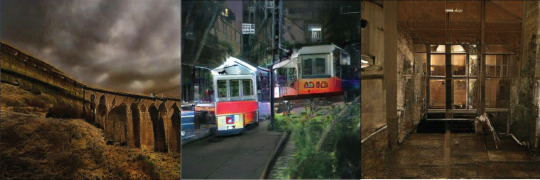
These are some of the most amazing generated images I’ve ever seen. Introducing BigGAN, a neural network that generates high-resolution, sometimes photorealistic, imitations of photos it’s seen. None of the images below are real – they’re all generated by BigGAN.
The BigGAN paper is still in review so we don’t know who the authors are, but as part of the review process a preprint and some data were posted online. It’s been causing a buzz in the machine learning community. For generated images, their 512×512 pixel resolution is high, and they scored impressively well on a standard benchmark known as Inception. They were able to scale up to huge processing power (512 TPUv3′s), and they’ve also introduced some strategies that help them achieve both photorealism and variety. (They also told us what *didn’t* work, which was nice of them.) Some of the images are so good that the researchers had to check the original ImageNet dataset to make sure it hadn’t simply copied one of its training images – it hadn’t.
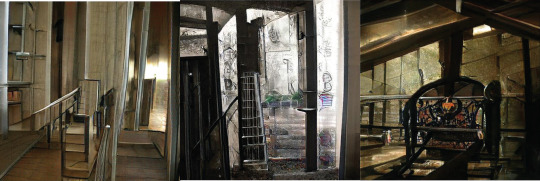
Now, the images above were selected for the paper because they’re especially impressive. BigGAN does well on common objects like dogs and simple landscapes where the pose is pretty consistent, and less well on rarer, more-varied things like crowds. But the researchers also posted a huge set of example BigGAN images and some of the less photorealistic ones are the most interesting.
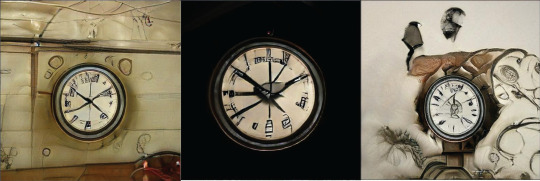
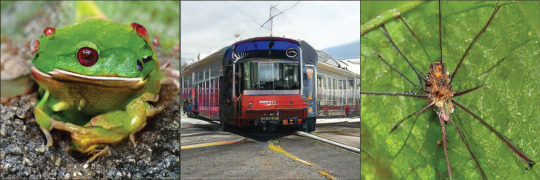
I’m pretty sure this is how clocks look in my dreams. BigGAN’s writing generally looks like this, maybe an attempt to reconcile the variety of alphabets and characters in its dataset. And Generative Adversarial Networks (and BigGAN is no exception) have trouble counting things. So clocks end up with too many hands, spiders and frogs end up with too many eyes and legs, and the occasional train has two ends.
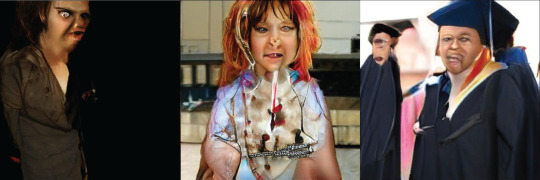
And its humans… the problem is that we’re really attuned to look for things that are slightly “off” in the faces and bodies of other humans. Even though BigGAN did a comparatively “good job” with these, we are so deep in the uncanny valley that the effect is utterly distressing.
So let’s quickly scroll past BigGAN’s humans and look at some of its other generated images, many of which I find strangely, gloriously beautiful.
Its landscapes and cityscapes, for example, often follow rules of composition and lighting that it learned from the dataset, and the result is both familiar and deeply weird.
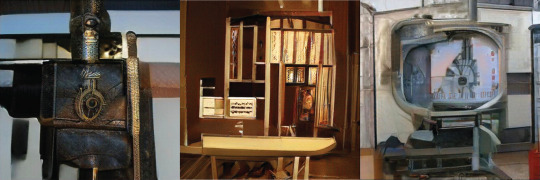
Its attempts to reproduce human devices (washing machines? furnaces?) often result in an aesthetic I find very compelling. I would totally watch a movie that looked like this.
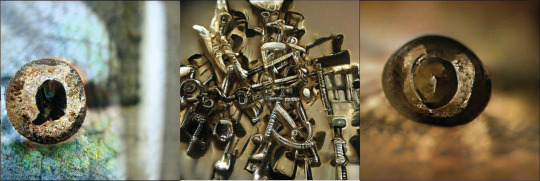
It even manages to imitate macro-like soft focus. I don’t know what these tiny objects are, and they’re possibly haunted, but I want them.
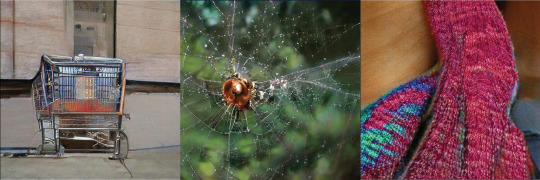
Even the most ordinary of objects become interesting and otherworldly. These are a shopping cart, a spiderweb, and socks.
Some of these pictures are definitely beautiful, or haunting, or weirdly appealing. Is this art? BigGAN isn’t creating these with any sort of intent – it’s just imitating the data it sees. And although some artists curate their own datasets so that they can produce GANs with carefully designed artistic results, BigGAN’s training dataset was simply ImageNet, a huge all-purpose utilitarian dataset used to train all kinds of image-handling algorithms.
But the human endeavor of going through BigGAN’s output and looking for compelling images, or collecting them to tell a story or send a message – like I’ve done here – that’s definitely an artistic act. You could illustrate a story this way, or make a hauntingly beautiful movie set. It all depends on the dataset you collect, and the outputs you choose. And that, I think, is where algorithms like BigGAN are going to change human art – not by replacing human artists, but by becoming a powerful new collaborative tool.
The BigGAN authors have posted over 1GB of these images, and it’s so fun to go through them. I’ve collected a few more of my favorites – you can read them (and optionally get bonus material every time I post) by entering your email here.
so, i only went in to get the shiny silvally code. should’ve taken like a minute or two at most but i was in there for upwards of ten. it was deeply unsettling right off the bat when i walked in because it was quiet. like really quiet. the tv that plays the gaming news and the speaker that plays the ads weren’t running. the cashier says hello and i get in line to wait. it is dead silent. nobody in the store is making any noise except for the cashier, who is typing. she’s helping a little boy sell 12 PS4 games. the boys mom is walking back and forth behind him sipping her gas station brand cup of coffee. literally just walking back and forth from one end of the store to the other. all the while the entire store is silent, the kid is silent, the mom is silent… all 5 of the other full grown adults in this store are silent. and i’m the only one in line behind this kid, these other adults throughout the store are like standing in one space just staring and being quiet. they weren’t browsing, they weren’t talking. nobody was making any noise. i wasn’t making any noise. i was standing there thinking about how eerily silent it was in this gamestop and wondering what the hell was going on – hyper aware of every move i made because i didn’t want to make a noise and break the silence. this carried on for literally 10 minutes before another cashier came in through the front door and loudly exclaimed “i can’t leave you alone for five minutes.” he called me to the counter and asked me what i needed help with. it was like immediately the ambient noises of gamestop all returned at once and i stepped forward to get my code.
my favorite part of this is the implication that not only was the first cashier somehow responsible for the eerie silence to begin with but also that this has certainly happened before
Fun fact: in the 1993 animated series The Adventures of Sonic the Hedgehog, the voice of Dr. Robotnik was performed by a famous English-Canadian blues singer named Long John Baldry. During his lifetime, Baldry produced over two dozen albums and had multiple Billboard-charting hits. After his move to Canada in the 1970s, he got into cartoon voice acting, taking on roles in shows like Star Wars: Droids, Captain N: The Game Master, ReBoot (did you ever wonder why Captain Capacitor sounded familiar?), and of course, Sonic the Hedgehog. In his personal life, he lived as openly gay starting in the early 1960s – a time when male homosexuality was still considered a jailable offence in the UK – and was reportedly friends with Elton John.
So every time you queue up a YouTube Poop? You’re hearing the voice of this man right here:
We’ll never know how Baldry would have felt about one of his most enduring pop-cultural legacies, as he died in 2004, several years before YTPs became well-known. I’d like to think, however, that he would have had a sense of humour about it!
Yes, Long John Baldry is indeed the man behind the pingas.
Apparently he was also the inspiration behind Elton John’s “Someone Saved My Life Tonight.” Which, boy, that’s a weird mixture of cultural legacies to leave behind…
















 PTA archive